Plan your visit to Akrotiri in Santorini
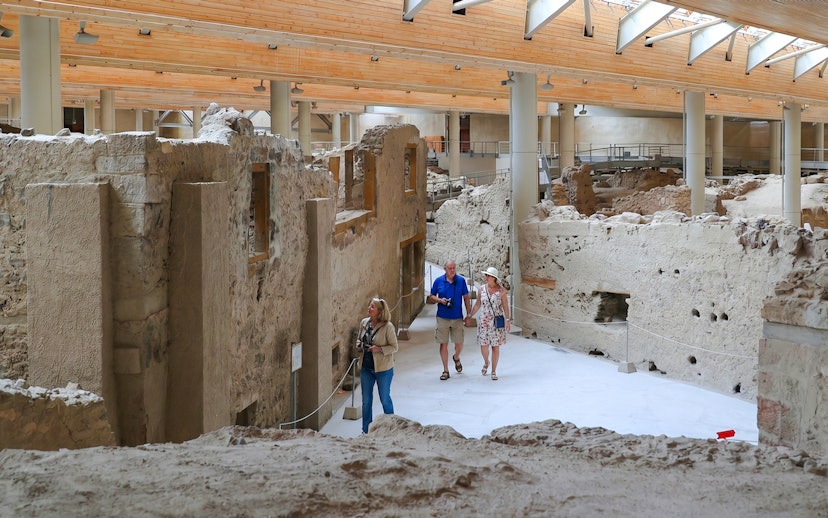
Akrotiri is a Bronze Age settlement on Santorini best known for its streets, houses, and drainage systems preserved under volcanic ash. The visit is easier physically than many ruin sites because it’s fully covered and explored on raised walkways, but it rewards a bit of planning more than people expect. What separates a good visit from a flat one is timing and context: late-morning tour groups can crowd the central sections, and the architecture makes much more sense if you arrive with a route or audio guide in mind.
Quick overview: Akrotiri at a glance
If you only read one section before you go, make it this one.
- When to visit: April–October, daily from 8am–8pm; November–March, from 8:30am–3:30pm, closed on Tuesdays. After 5pm is noticeably calmer than 10am–2pm, as cruise groups and coach tours cluster in the late morning.
- Getting in: Standard entry starts from €20. Guided tours usually start around €40–€60. You can still buy tickets at the door, but late-morning slots can fill up 1–2 days in advance, especially in July and August, so it’s safer to book ahead.
- How long to allow: 1–2 hours for most visitors. Expect to stay closer to 2 hours if you use an audio guide, read the panels, and watch the reconstruction film at the end.
- What most people miss: The short 3D reconstruction film and the the connection to the Museum of Prehistoric Thera in Fira are what make the ruins feel complete, not just architectural.
- Is a guide worth it? Yes, if you want the city to feel legible rather than abstract; if you’ve read up in advance, a downloaded audio guide usually gives enough context for less.
🎟️ Late-morning slots for Akrotiri can disappear 1–2 days in advance in July and August. Lock in your visit before the time you want is gone.
See ticket options
Jump to what you need
🕒 Where and when to go
🎟️ Which ticket is right for you?
🗺️ Getting around
♿ Facilities and accessibility
Where and when to go
How do you get to Akrotiri?
Akrotiri sits on Santorini’s south-west coast near Akrotiri village, about 12km from Fira and close to Red Beach, so it’s straightforward to reach even without a car.
Akrotiri Archaeological Site, Akrotiri, Santorini, Greece
→ Open in Google Maps (Akrotiri Archaeological Site)
- Bus: Fira central bus station → Akrotiri stop → the bus drops you right at the entrance on the summer route.
- Car: From Fira → about 20 minutes → the drive is simple and well-signposted once you’re on the southbound island road.
- Taxi / rideshare: From Fira → about 20 minutes → useful if you want to pair the site with Red Beach or the lighthouse without waiting on return buses.
- Parking: Paid parking sits directly opposite the entrance, with a few free roadside spots farther away that fill first on busy summer mornings.
Which entrance should you use?
Akrotiri has one main entrance, but the experience changes depending on whether you already have a timed ticket. The most common mistake is arriving in the late morning without pre-booking and then finding the slot you wanted is already busy.
- Pre-booked tickets: For timed-entry ticket holders. Expect 0–10 minutes’ wait outside the peak 10am–2pm rush.
- On-the-day tickets: For same-day buyers at the booth. Expect 10–20 minutes’ wait in summer, longer if a popular slot is already full.
- Free or reduced admission: For eligible visitors using ID-based discounts or free entry. Expect a short document check before you join the main flow.
When is Akrotiri open?
- April–October: 8am–8pm
- November–March: 8:30am–3:30pm
- Tuesdays in winter: Closed
- Last entry: Around 30 minutes before closing
When is it busiest? Late morning, especially 10am–2pm in July and August, is the crunch window when cruise groups and island coach tours overlap around the central square.
When should you actually go? After 5pm in summer is the easiest slot because the tour buses thin out, the covered roof keeps the site comfortable, and you can move through the main streets without bottlenecks.
Which Akrotiri ticket is best for you
| Ticket type | What's included | Best for | Price range |
|---|---|---|---|
Akrotiri Ticket with Audio Guide | Entry to the Akrotiri archaeological site + self-guided audio tour of Fira Old Town + optional Akrotiri audio guide upgrade | Visitors who want a flexible self-guided experience combining Santorini’s Bronze Age ruins with the atmosphere and history of Fira Old Town at their own pace | From €26 |
Archaeological Bus Tour to Akrotiri Excavations & Red Beach | Full-day guided Santorini tour + shared AC transfers + visits to Akrotiri, Red Beach, Megalochori, Perivolos Beach, and Prophet Elias Monastery | Travelers who want a relaxed full-day Santorini itinerary combining ancient ruins, traditional villages, scenic viewpoints, and beach time without planning transport separately | From €49 |
Day Trip to Akrotiri & the Majestic Spots of Santorini | Full-day guided Santorini bus tour + shared AC transfers + English-speaking guide + visits to Akrotiri, Red Beach, Pyrgos, Fira, Oia, and Prophet Elias Monastery | Visitors who want Santorini’s biggest scenic, cultural, and sunset highlights covered in one easy full-day itinerary without arranging separate transport between stops | From €51 |
How do you get around Akrotiri?
The layout at Akrotiri
Akrotiri is best explored on foot, and most visitors can cover the full public route in about 1–2 hours. The entrance brings you onto a raised walkway, and the main cluster of streets and buildings sits directly ahead rather than spread across a huge open site.
- West House / Xeste 3 area: Some of the best-preserved domestic buildings → look for staircases, niches, and fresco context → budget 15–20 minutes.
- Triangle Square and Delta Complex: The site’s urban center → best place to understand how the city functioned as a lived-in settlement → budget 15–20 minutes.
- Street of the Telchines: The clearest surviving street line → great for seeing paving, drainage, and building fronts together → budget 10–15 minutes.
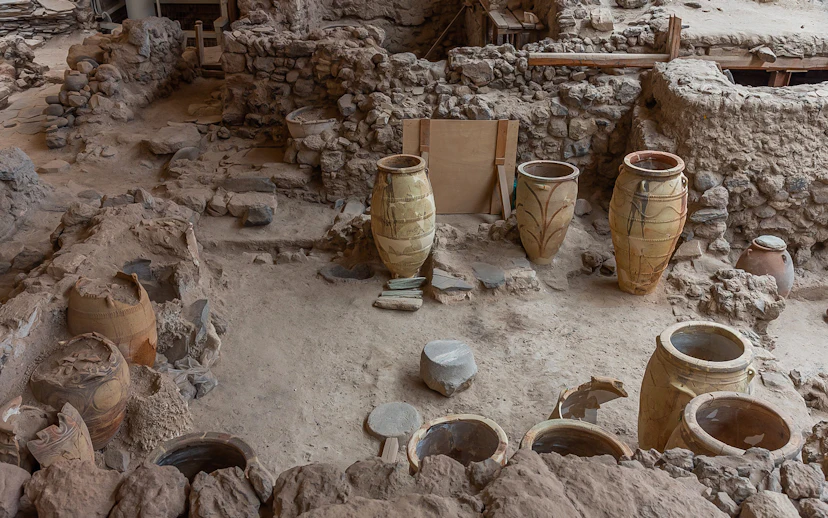
- Workshop and storage areas: Pithoi, craft spaces, and practical infrastructure → the best section for everyday life rather than elite houses → budget 10–15 minutes.
Suggested route: Start with the West House and Xeste 3 while your attention is fresh, then move into Triangle Square and the Street of the Telchines; most visitors rush straight through the workshop sections, even though they explain how prosperous and organized the town really was.
Maps and navigation tools
- Map: On-site signage and entrance material cover the main route → enough for the basic loop → pick it up or screenshot it before you start.
- Signage: Good enough for a first pass, but not detailed enough to explain every building name or function without extra prep.
- Audio guide/app: Phone-based guides add real value here → download before arrival because signal can be patchy once you’re inside the shelter.
💡 Pro tip: Download your audio guide before you arrive. Akrotiri is easy to walk, but much harder to interpret once you’re inside and trying to match building names to the route.
What is Akrotiri worth visiting for?

Xeste 3 (House of the Ladies)
Era: Late Bronze Age Minoan
This is one of the most important buildings on the site, both architecturally and symbolically. It’s tied to some of Akrotiri’s best-known frescoes, including the saffron-gathering scenes, and it helps you picture the settlement as a sophisticated town rather than a pile of walls. Most visitors focus only on the fresco story and miss the surviving staircases, niches, and room layout that make the house feel lived in.
Where to find it: On the main raised route near the early part of the visit, clearly marked in the West House / Xeste section.
Triangle Square and the Delta Complex
Type: Urban center
This is where Akrotiri starts to feel like a real city. You can see the shape of a public square, the relationship between streets and buildings, and the dense layout that supported trade and daily movement. What people often rush past here is the original paving and the sense of scale but it’s one of the easiest places to imagine crowds, commerce, and ordinary routines.
Where to find it: Near the center of the visitor circuit, where several walkways converge around the site’s main open plaza.
Street of the Telchines
Type: Main street
If you want one section that explains Akrotiri’s urban planning, make it this one. The preserved paving, street line, and visible building edges show how ordered the settlement was long before the Classical Greek period. The detail most people miss is the wear in the stone and the drainage running alongside it, which turns the street from a backdrop into proof of a working city.
Where to find it: Along the central route running past the dense cluster of houses and workshops.
Artisan workshops
Type: Economic and industrial area
These spaces matter because they show Akrotiri wasn’t only ceremonial or residential but was productive, busy, and commercially connected. Pottery, storage, and traces of craft work make the site feel less aristocratic and more complete. Many visitors skim these zones because they are less photogenic than the big houses, but they’re where the town’s prosperity becomes easiest to understand.
Where to find it: Along the later sections of the walkway, near the storage jars and practical-use rooms away from the headline domestic buildings.
The drainage system
Type: Urban engineering
Akrotiri’s drainage and sewer network is one of the most impressive details on-site because it reveals how advanced the settlement was beneath the surface, not just above it. Terracotta pipes and planned water channels show careful design across the town. Most people notice the walls first and miss the plumbing completely, even though it’s one of the clearest reasons Akrotiri stands apart from many ruin sites.
Where to find it: Best spotted beneath or beside the streets, especially in sections where the information panels explain the pipe layout.
The 3D reconstruction film
Type: Interpretation feature
This short film is the piece that helps the whole visit click. It reconstructs the town’s roofs, rooms, wall paintings, and street life, which is especially useful because the original frescoes and smaller finds are no longer at the site. Many visitors walk straight out once they finish the circuit and miss the one feature that turns the ruins from impressive to understandable.
Where to find it: At the end of the visitor route in the welcome or interpretation area.
Facilities and accessibility
- 🎒 Cloakroom/lockers: Large bags are not allowed on the site, and there is storage at the entrance for backpacks or luggage.
- 🚻 Restrooms: Restrooms are available at the entrance area, and they are easier to use before you start the walkway than midway through the visit.
- 🍽️ Café: There is a small on-site café for basic drinks and light refreshments, but it works better as a convenience stop than a destination meal.
- 🛍️ Gift shop/merchandise: A small kiosk or shop near the exit sells booklets and simple souvenirs, and the site guide is one of the more useful things to buy if you want context.
- 🪑 Seating/rest areas: Benches are placed along parts of the route and near the film area, which helps if you want to pause without leaving the site flow.
- 🅿️ Parking: Paid parking sits directly opposite the entrance, and the closest free roadside spaces usually go first on busy summer mornings.
- ♿ Mobility: Akrotiri is one of the more accessible archaeological sites in Greece, with ramps, raised boardwalks, an entrance lift, and a route that avoids rough ground.
- 👁️ Visual impairments: This is still a very visual site, so many visitors get more from it with a companion, guide, or audio guide rather than relying on signage alone.
- 🧠 Cognitive and sensory needs: Late afternoon is the calmest low-stimulus window, while late morning is the noisiest and most crowded around the central square and bigger tour clusters.
- 👨👩👧 Families and strollers: Strollers can manage the main route, baby-changing is easiest near the entrance facilities, and the walkways are much more pushchair-friendly than open ruin sites.
Akrotiri works well for children who like stories, ruins, and volcanoes because it feels more like walking through a buried town than standing in a formal museum.
- 🕐 Time: Around 60–90 minutes is realistic with young children, and the West House, main square, and reconstruction film are the best sections to prioritize.
- 🏠 Facilities: The covered roof, entrance restrooms, seating, and stroller-friendly walkways make this one of Santorini’s easier cultural stops with kids.
- 💡 Engagement: Frame the visit as a real city frozen by ash, then ask children to spot staircases, jars, pipes, and streets rather than expecting them to follow every historical detail.
- 🎒 Logistics: Bring water, hats for the time before and after the visit, and a downloaded audio guide if older children like stories; skip bulky bags because storage slows your arrival.
- 📍 After your visit: Red Beach is the easiest child-friendly add-on nearby if your family needs open space and a visual change after the ruins.
Rules and restrictions
What you need to know before you go
- Entry is by ticket or timed online booking, and you should carry ID if you’re using a free or reduced-admission category.
- Large bags and luggage should be left at the entrance storage area rather than brought onto the visitor route.
- Re-entry is not permitted after you leave, so do the restrooms, café stop, and bag check before you start your circuit.
Not allowed
- 🚫 Large luggage is not allowed inside the archaeological route because the raised walkways are narrow and the site needs protection from accidental damage.
- 🚫 Climbing, touching, or leaning into the ruins is not allowed, both for your safety and to protect fragile structures that have survived for millennia.
Photography
Photography is generally allowed from the raised walkways, and Akrotiri is one of the easier ruin sites for taking clear overview shots because the route keeps you elevated above the buildings. The main distinction is between the open archaeological circuit and any display or interpretation material where separate posted rules may apply. Hand-held photography is the simplest option here, and you should avoid any setup that blocks the boardwalk or encourages leaning past barriers.
Good to know
- The original frescoes and smaller artifacts are not at Akrotiri itself, so pair the site with the Museum of Prehistoric Thera in Fira if you want the full story.
- Only about one-third of the ancient city has been excavated so far, which helps explain why the visit feels compact even though Akrotiri was once much larger.
Practical tips
- If you want a late-morning slot in July or August, book 1–2 days ahead rather than assuming you can just walk up and get the exact time you want.
- Arrive 10–15 minutes before your slot, especially if you need a reduced or free ticket check, because ID verification and bag storage can add small delays, even when the site itself is flowing well.
- Save your attention for the central streets and Xeste 3 rather than reading every panel in sequence; the site makes more sense once you’ve seen the city layout first.
- Late afternoon, especially after 5pm in summer, is the sweet spot here because the coach groups have usually thinned out, and the covered roof keeps the site comfortable well past the hottest part of the day.
- Bring a small bag, not a beach-day loadout; security and storage are easier, and you’ll move much more comfortably on the walkways.
- Eat either before you enter or after you finish, because the on-site café is best for a quick drink, and the better lunch spots are outside the gate.
- If you’re visiting independently, download your audio guide before you leave Fira or your hotel; on-site signal can be patchy, and Akrotiri is much richer when the buildings have names and stories attached to them.
- Pair Akrotiri with the Museum of Prehistoric Thera later the same day if you can, because the ruins explain the city plan, and the museum gives you the frescoes, objects, and missing visual layer.
What else is worth visiting nearby?
Commonly paired
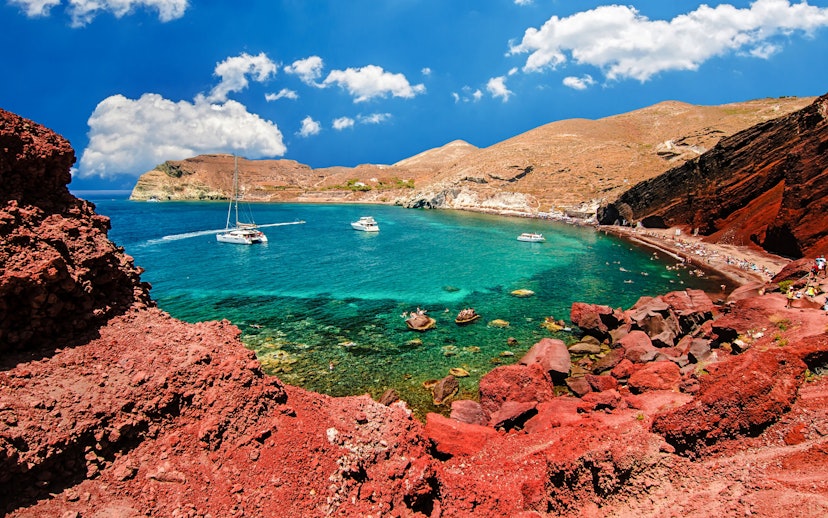
Red Beach
Distance: About 700 m, 10 minutes on foot
Why people combine them: It’s the easiest add-on after the ruins, giving you a dramatic landscape stop immediately after the historical visit without getting back in a car or bus.
Commonly paired
Museum of Prehistoric Thera
Distance: About 12 km, 25 minutes by bus or car
Why people combine them: Akrotiri makes the city understandable, and the museum in Fira gives you the frescoes, pottery, and artifacts that are no longer displayed on-site.
Also nearby
Akrotiri Lighthouse
Distance: About 4 km, 10 minutes by car
Worth knowing: It’s one of Santorini’s calmer sunset viewpoints, so it works especially well if you visit Akrotiri in the late afternoon and want to stay in the area.
Castle of Akrotiri
Distance: About 1 km, 15 minutes on foot uphill
Worth knowing: The ruins are modest, but the village setting and quieter feel make this a nice short detour if you want a break from Santorini’s busier centers.
Eat, shop and stay near Akrotiri
- On-site: The small café at the entrance is fine for coffee, water, and a quick reset, but it’s more useful as a convenience stop than a proper meal.
- The Cave of Nikolas (5-minute drive, Akrotiri waterfront): Seafood and Greek dishes in a classic taverna setting, and it’s one of the most natural post-visit lunch stops if you want to stay in the south of the island.
- Boutari Winery (15-minute drive, Megalochori): Better for a light tasting stop than a full meal, but it works well if you want to trade archaeology for Santorini wine without heading back to Fira.
- Venetsanos Winery (20-minute drive, Megalochori): A stronger fit for views and wine than a full lunch, and a good option if you want an afternoon pairing after a morning at Akrotiri.
- 💡 Pro tip: f you’re visiting between 10am and 12 noon, finish the site first and eat after, as that’s the busiest window inside Akrotiri and lunch tastes better once you’re not checking the time.
- On-site gift kiosk: Best for a site guide, simple souvenirs, and something practical to help decode what you just saw rather than generic Santorini merchandise.
- Boutari Winery shop: Worth a look if you want a bottle that actually ties back to the island’s volcanic landscape rather than a standard souvenir.
- Venetsanos Winery shop: A good stop for wine-focused gifts if you’re already heading toward the caldera side after your visit.
Akrotiri is a quiet base rather than a central one. It suits travelers who want slower evenings, easy access to Red Beach and the lighthouse, and don’t mind using a car or bus for the rest of Santorini. If you want to walk to lots of restaurants, shops, and nightlife, this is not the easiest part of the island to base yourself in.
- Price point: The area usually skews quieter and more mid-range than Fira or Oia, with the biggest value coming from space and calm rather than luxury views.
- Best for: Short stays built around beaches, sunsets in the south, and travelers who want Akrotiri, Red Beach, and the lighthouse close together.
- Consider instead: Fira works better if you want bus connections and easy museum access, while Oia or Imerovigli suit longer stays built around caldera views and restaurant-heavy evenings.
Frequently asked questions about visiting Akrotiri
Most visits take 1–2 hours. Around 60–90 minutes is enough for the walkway circuit, but you’ll want closer to 2 hours if you use an audio guide, stop at the main houses and streets properly, and watch the short reconstruction film at the end.
No, you don’t always need to book in advance, but it’s smart in July and August. Same-day purchase is often fine in quieter months, while popular late-morning summer slots are the most likely to fill first because that’s when group tours and cruise visitors overlap.
Yes, it can be worth it in peak season, mainly because it removes the risk of waiting at the ticket booth or missing your preferred entry time. Akrotiri doesn’t have huge fortress-like lines every day, but timed pre-booking helps most from 10am to 2pm in summer.
Arrive 10–15 minutes before your slot. That gives you enough time for ticket checks, any ID verification for reduced or free entry, and bag storage if you’ve brought more than a small day bag.
Yes, but keep it small. Large bags and luggage are better left at the entrance storage area, because the raised walkways are not designed for bulky items and bringing too much slows you down before you even start.
Yes, photography is generally allowed on the main visitor route. The easiest shots are wide views from the raised walkways, and hand-held photography is the most practical because the site is narrow in places and barriers need to stay clear.
Yes, and guided groups are common here. If you’re joining one, late morning is the busiest time, so smaller groups or later starts usually feel more comfortable inside the central sections of the site.
Yes, especially for children who like volcanoes, buried cities, and real-world history. The covered roof, manageable 60–90 minute route, and stroller-friendly walkways make it easier than many archaeological sites, though younger children still get more from a story-led visit than a detail-heavy one.
Yes, Akrotiri is one of the more accessible ruin sites in Greece. Ramps, raised boardwalks, and an entrance lift make the main route much easier than uneven open-air sites, though it’s still worth moving at a relaxed pace because it remains an archaeological environment, not a modern gallery.
Yes, there is a small café on-site and better meal options nearby. Most visitors use the café for a quick drink, then head to Akrotiri waterfront or back toward Megalochori for a more satisfying lunch after the visit.
No, the original frescoes and smaller finds are displayed at the Museum of Prehistoric Thera in Fira. At the site itself, what you’re seeing is the preserved city layout, architecture, streets, and infrastructure, which is why many visitors pair both stops on the same day.
Many younger visitors qualify for free entry, but they still need the correct ID or age proof. It’s worth checking the current eligibility rules before you go, because Greek archaeological sites apply different free and reduced categories depending on age, nationality, and student status.